
A failing wood floor is usually a symptom, not the whole story. Cupped boards, a soft spot underfoot, a floor that slopes toward one wall, or planks that have lifted after a leak all point back to what's happening beneath the surface. At Wood Floors Houston, wood floor repair starts with finding the real cause - moisture, a settling subfloor, an old installation that was never leveled - and then fixing it so the problem doesn't return. We've repaired and leveled hardwood floors across Houston, The Woodlands, Spring, Conroe, Huntsville, Willis, Kingwood, Humble, Pearland, Missouri City, Tomball, Cypress, Katy, and nearby Texas communities, and the goal is always the same: a sound, flat, seamless floor you'd never guess had been touched.
If your floor is structurally fine but simply worn or dated, you may only need sanding and a fresh finish rather than a repair. We'll tell you honestly which one you're looking at. Call 281-809-2100 for a free in-home assessment.
Floor leveling & subfloor repair
Many Houston homes sit on slabs and pier-and-beam foundations that move with the region's expansive clay soil. Over time that movement shows up in the floor as dips, high spots, and that hollow "give" when you walk across a room. Before we lay or repair a single board, we check the subfloor for flatness, moisture, and structural soundness, then correct it.
- Subfloor diagnosis - locating dips, high spots, and the source of slope or movement
- Self-leveling underlayment and shimming to bring slabs and wood subfloors back into plane
- Replacing rotted or water-damaged subfloor and screeds before new wood goes down
- Re-securing loose subfloor panels and joist work to eliminate squeaks and bounce
- Moisture testing and troubleshooting so the floor stays flat after the repair
Damaged board replacement & weaving
When only part of a floor is damaged, there's no reason to tear out the whole thing. We remove the failed planks and weave in matching boards so the repair flows into the surrounding wood instead of standing out as a patch. The trick is matching species, board width, grain, and finish - and feathering the new wood into the old during sanding and refinishing.
- Water-damaged, cupped, crowned, and warped board replacement
- Board weaving that staggers new planks into the existing field for an invisible repair
- Gap and crack repair, plus filling and re-securing separated boards
- Squeak elimination and re-nailing of loose or popped boards
- Stair tread, transition, and threshold repair to match the main floor
When to repair vs. refinish
Not every tired floor needs structural work. Surface scratches, dull spots, and light wear are a finishing job. Repair becomes the right call when the wood itself or what's under it has failed. Here's how we think about it during the walkthrough:
- Repair & level when boards are loose, missing, water-damaged, or the floor is uneven and unstable
- Sand & refinish when the floor is solid but scratched, faded, or worn through the topcoat
- Often both - we repair and level first, then sand and finish the whole floor as one surface
- We give you the honest version, including when a quick repair will buy you years before a full redo
Need a fresh finish after the repair? See our sanding & finishing work, or learn how we handle water damage & moisture protection to keep repairs from coming back.
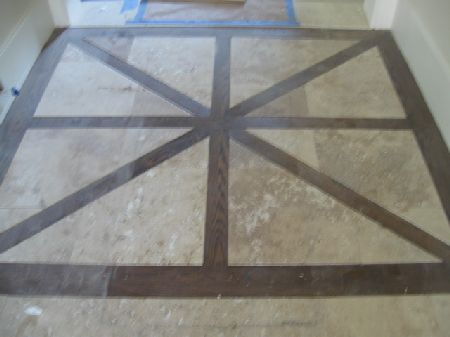
Subfloor & leveling
We flatten slabs and wood subfloors, replace rotted material, and stop bounce and squeaks at the source.
Board replacement
Failed planks are removed and woven back in with matched species, width, and grain for a seamless repair.
Water & moisture
We pinpoint the moisture source first, then repair the damage so cupping and lifting don't return.
Repairs you'd never notice
The measure of a good wood floor repair is that no one can find it. Once boards are replaced and the floor is leveled, we sand the repaired area into the surrounding field and bring the finish back across the whole surface so color and sheen are uniform end to end. The honey-brown red oak below was repaired and refinished this way - the new and original boards now read as one continuous floor.
- Color and sheen matched across new and original boards
- Flat, stable floor with no dips, squeaks, or soft spots
- Repairs blended into the field instead of patched over
- One crew handling repair, leveling, sanding, and finishing

Got a squeak, a soft spot, or a damaged board? Let's take a look.
We'll come to your home, find the real cause, and give you an honest, no-pressure estimate for the repair.